Which ski brands AI assistants recommend in Austria
Six AI engines, twelve brands and fifteen manufacturer websites: the recommendations German-language AI answers give someone buying skis, the sources those recommendations come from and the brands the answers never reach.
AI, TELL ME! Ski Hardware Visibility Study, Austria. Written by a co-founder of AI, TELL ME! Published 24 September 2026. Answer data collected September 2026, website data collected 7 to 20 September 2026.
Short answer. Across 120 AI answers to German-language ski-buying questions in Austria, six AI engines named twelve ski brands between them. Atomic, Salomon and Rossignol hold 63.5% of all brand mentions, six manufacturers selling into the same market were named nothing at all, and 89.7% of the citation weight behind those answers sits on websites no ski brand controls. Which brand an assistant names is decided away from the brand's own website. Whether it can be named at all is decided on it.
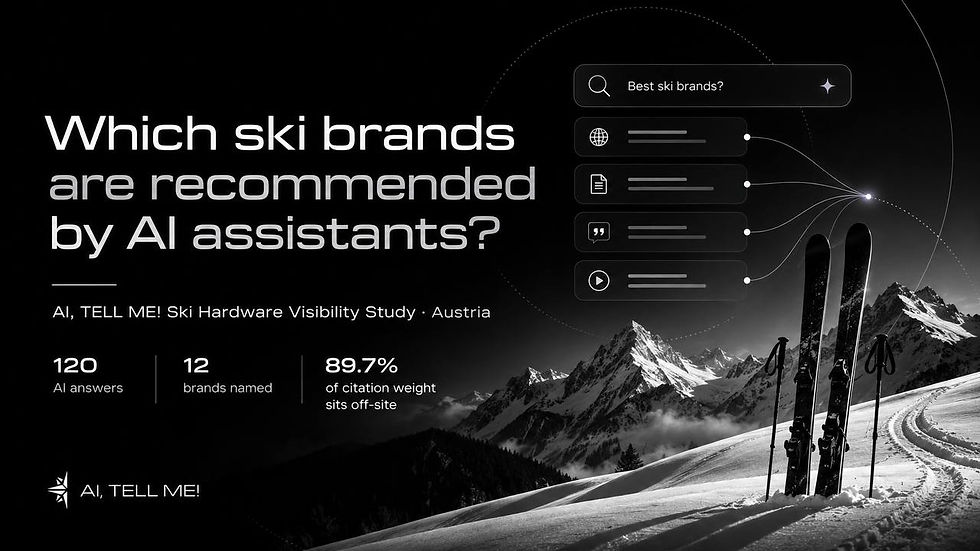
Someone in Austria opens an AI assistant in September and asks which skis to buy for the season. Across a monitoring run covering alpine and cross-country questions, twelve ski brands were named 705 times between them. Six further manufacturers selling into the same market were named zero times, across every engine and every question in the run. The answers doing the naming were assembled from 114 public sources, of which the ski brands themselves own six.
Scope and method
AI, TELL ME! is a full-cycle AEO and GEO agency. We deliver AI search optimisation as a service, and we operate our own monitoring and website assessment tools, which produced both halves of this study: the monitoring platform that records what each AI engine says and cites, and the AI Access Report that records what those engines' crawlers can reach and read on a website.
Running our own tools means we set the methodology, so every figure below traces back to the run that produced it. The prompt set, the engine list, the page sampling rule and the confidence levels applied to each finding are all documented in the methodology section at the end.
The monitoring ran in German for the Austrian market:
Two segments: alpine skis (Alpinski) and cross-country skis (Langlaufski).
Six engines: ChatGPT, Google AI Mode, Claude, Gemini, Perplexity and Google AI Overview.
120 answers, 114 distinct cited domains and 369 cited URLs.
Buyer questions in the shapes people use when they are about to spend money: a first purchase before a trip, buying for a partner, fit by body height, terrain, usage frequency and attribute-led questions about grip, glide and control through a turn.
This run was deliberately small, at ten prompts per segment. A test run of that size establishes the shape of a category and the source set behind it, and it is too thin to read as a ranking. Full monitoring runs 50 prompts per segment on a weekly cycle, since daily runs add noise without adding information, and two readings a fortnight apart are what separate a brand's standing from the run-to-run variance these systems produce on their own.
Fifteen manufacturer websites were measured alongside the answers. The site check samples page templates instead of whole sites, at up to 25 pages per site, and the methodology section at the end sets out the sampling rule and the limits in full.
Definitions: how to read the numbers in this study
Five measures carry most of the findings below, and each one answers a different question.
Share of voice: the share of all brand mentions in the monitored answers that belongs to one brand. A brand at 23% owns roughly one in four mentions in its category. Share of voice describes conversational presence, and it measures neither traffic nor revenue.
Absence rate: the answers in which a brand was not named at all. Two brands can hold similar share of voice while one of them is missing from a third of all answers.
Citation weight: how much of the sourcing behind the answers rests on one domain, combining how often that domain is used with how prominently it is used. It moves independently of raw citation counts, so a domain cited rarely and prominently can outweigh one cited often and in passing.
Citation consistency: the share of monitored answers in which a given source appears. A source at 33% consistency is behind one answer in three.
Content extraction score: how much of a page a retrieval pipeline recovers as content once menus, filters and footers are stripped, measured with the same extractor those pipelines run. It is reported here as a score out of 100, alongside the raw percentage of visible text the extractor keeps. Those two numbers are related and not interchangeable.
Passage quality: how well a page survives being cut into the passages an answer is built from, covering whether each passage stands on its own, whether sections are marked, and whether the opening paragraph answers the page heading.
Which ski brands do AI assistants recommend in Austria?
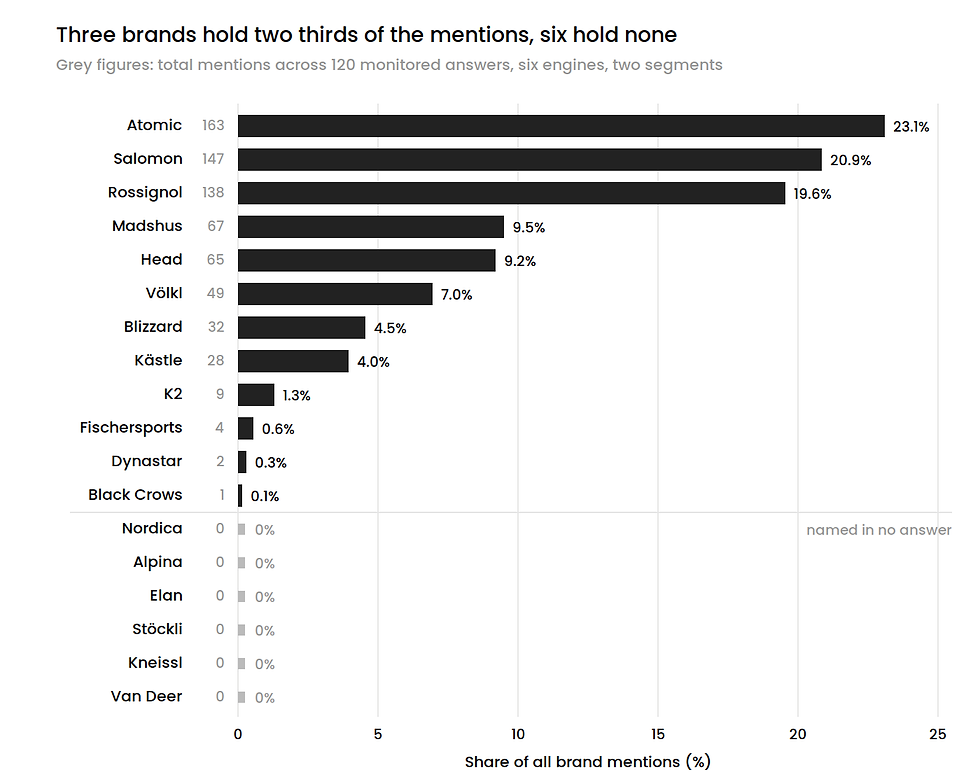
The field splits into four tiers:
Three brands above 19% share of voice, holding 63.5% of all mentions between them: Atomic at 23.1%, Salomon at 20.9% and Rossignol at 19.6%.
Five brands between 4% and 10%: Madshus, Head, Völkl, Blizzard and Kästle.
Four brands sharing the remaining 2.3%: K2, Fischersports, Dynastar and Black Crows, the last of these named a single time in the whole run.
Six brands at zero, named in no answer by any engine.
Madshus holds its 9.5% through a change of ownership: the Norwegian cross-country brand halted production and has since been acquired by ConsilTech, which also owns Kästle.
For the brands lower down, absence is the more useful figure. Three of the twelve named brands were never produced by ChatGPT in any answer, and one appeared in Google AI Overview alone. Behind a low share-of-voice number sits the operational fact, that a buyer asking an ordinary question gets a shortlist the brand is missing from entirely.
Why do ChatGPT, Claude, Gemini and Perplexity recommend different brands?
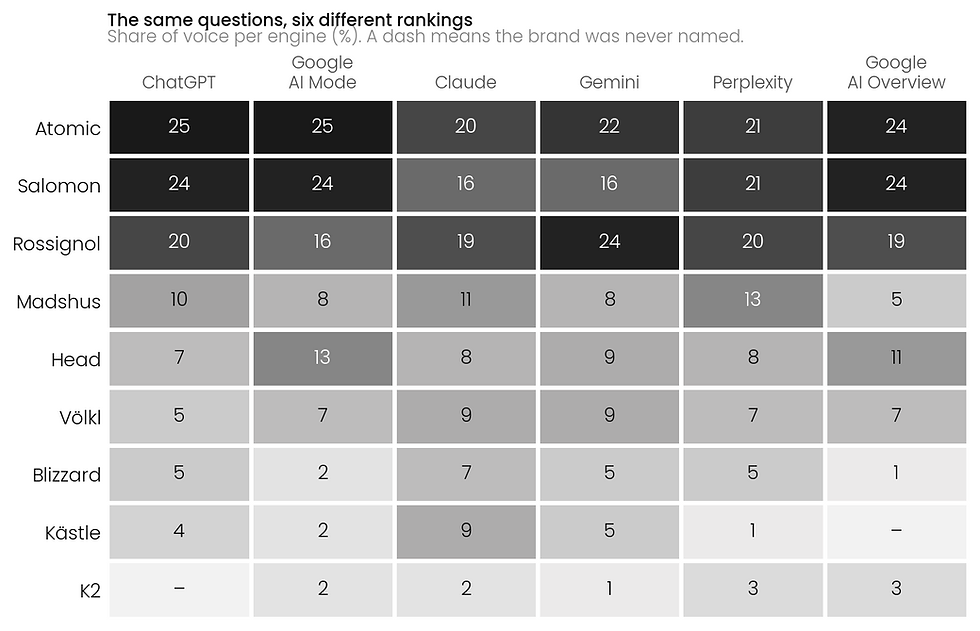
No two engines produced the same order, because each one draws on a different mix of what its model already holds and what its retrieval step fetched that day:
Rossignol leads Gemini at 24% while sitting third overall.
Head moves from 7% in ChatGPT to 13% in Google AI Mode, near doubling on identical questions.
Kästle reaches 9% in Claude and disappears from AI Overview altogether.
Madshus holds 13% in Perplexity and 5% in AI Overview.
The risk in that spread is a reporting one, since a brand checking its visibility in one assistant, usually the one the marketing team happens to use, is reading a sixth of its market and calling it the market. For the mid-tier brands here the gap between best and worst engine runs to as much as nine percentage points, wider than the gap separating fourth place from seventh.
Where do AI assistants get their brand recommendations from?
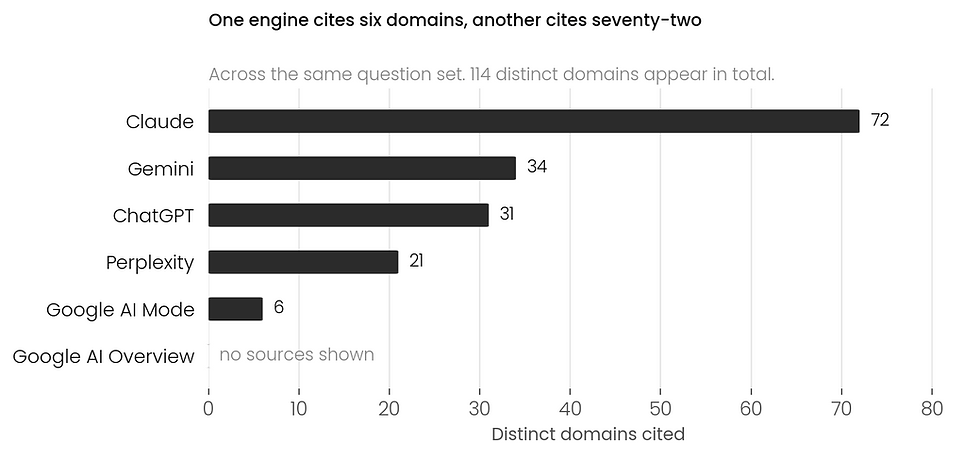
Engines differ as much in how they source as in what they say. Claude cited 72 distinct domains, Google AI Mode cited 6, and AI Overview returned no source links in this run. An answer without visible citations leaves no trail showing which pages shaped it, while an answer citing 72 domains is composed live from whatever the retrieval step found that day. The narrow surfaces are the hardest to enter, because six domains leaves very little room.
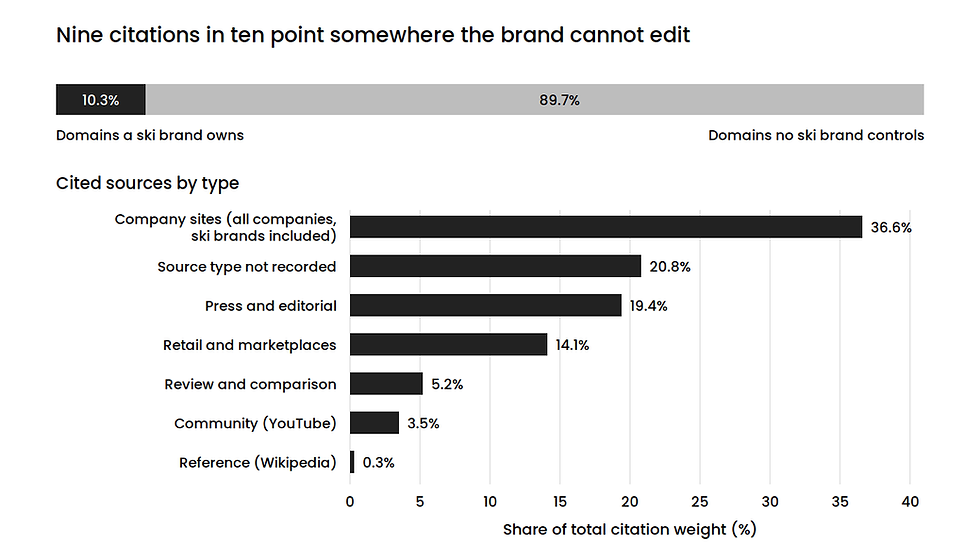
Ski brands own 6 of the 114 cited domains and carry 10.3% of citation weight between them. The other 89.7% sits on domains no ski brand controls: other companies' websites, press and editorial, retailers and marketplaces, review and comparison sites, YouTube and Wikipedia, plus a fifth of the weight that the export left without a source type. On those pages a brand has influence through relationships and none through a CMS. Four figures set the shape of that source set:
Retail and marketplace domains carry more citation weight than every manufacturer site combined.
The ten highest-weighted domains hold 42.5% of all citation weight, so a segment's AI visibility is decided on a handful of pages.
64 of the 114 domains (56%) were cited exactly once.
Six of the twelve named brands have no owned domain anywhere among the 114 cited sources, so every citation they receive comes from a page somebody else controls.
The most-cited source in this study is one specialist cross-country test site, and a single test page on it supplied the sources for twelve separate answers. One well-built comparison page, run independently of the manufacturers, is moving an entire segment.
How the manufacturer websites look to an AI crawler
Citations land on pages a machine could read, so fifteen manufacturer sites were measured alongside the answers: the AI crawler identities sent against the home page, pages rendered in a headless browser to see what JavaScript hides, the same text extractor retrieval pipelines run, structured data, passage quality and speed. The sites are anonymised in this section and the next, because a single probe cannot prove what a live AI crawler receives from a given server.
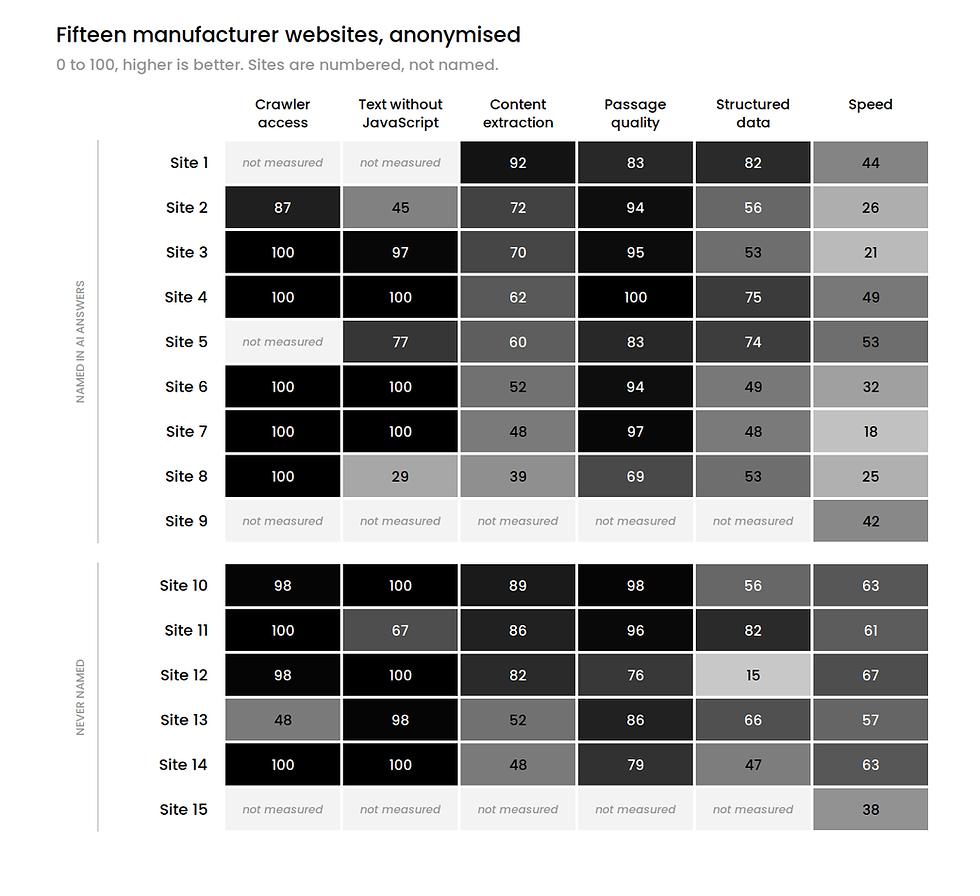
Thirteen of the fifteen allow every AI crawler in robots.txt, and two carry Disallow rules against the crawlers that feed AI answers. The behaviour underneath robots.txt varies:
Seven sites served a normal 200 to every crawler that fetches pages, with no reduced version, so nothing needs fixing there.
Two more served every citation crawler cleanly while refusing the training crawlers, which is often a deliberate policy and worth confirming as one.
One site redirects twelve of fourteen crawlers to a country picker with no heading and no content, and the two that reach the real home page are the ones firing because a person asked. The risk: the home page stored against that brand is a list of countries, so the brand's own top-level description never enters the index.
Two sites answered 429 to the check, one after thirty-four requests and one after five. A rate limit is ordinary protection; a threshold tuned for a human reader catches a crawler working through a thousand product pages in minutes, and the server logs are the only place to see whether that is happening.
Two sites refused every crawler name with a 403 through a bot manager, which is worth checking against the policy the company intends.
Past the door, the content is where the ski hardware category loses ground:
Content extraction ran from 10% to 80% of visible text across the fifteen sites. On the weakest sites the extractor returns the description mixed with menus, filters and cross-sell blocks, so the passage a retrieval step scores reads partly as navigation, and a passage reading like a menu loses to one reading like an answer.
Structured data covers every sampled page on seven sites, sits under a third of pages on three, and is absent altogether on three more. On three sites the JSON-LD type names are lower-cased, which makes the markup invisible to a parser while looking present to anyone inspecting the page.
Twelve of the thirteen sites where it could be measured carry no machine-readable publication date on any sampled page. On a product page that date is what says the price and the availability still hold, and without it the page competes against dated third-party test pages a retrieval step can confirm are current.
Passage quality is the category's strongest dimension, at 69 to 100. The weak readings sit where the opening paragraph fails to answer the page heading: an answer is assembled from passages, and the first passage taken is the one under the heading, so a marketing run-up there costs the whole passage.
Two sitemaps lose about a third of their addresses to 404 and 410 responses, almost all of them products, so a crawler spends its visit on pages that no longer exist.
Three sites sit in the slow band for field visitors, with layout shift up to 0.52 against a 0.1 threshold. Layout shift costs the visit after the AI answer has already sent someone.
Four of the fifteen publish an llms.txt. The convention is young enough that nobody can say what it is worth, which is the reason to note who is experimenting.
Why does a brand never appear in AI answers?
Six manufacturers selling ski hardware in Austria were named in none of the 120 monitored answers, and a seventh was named once. Their website measurements fall into three groups, and the sites stay anonymised here for the reason given above.
In the first group the door is shut, in one case apparently without the company meaning to shut it. One never-named manufacturer's server refused three of the crawlers that feed AI answers while serving three others in the same run, its robots.txt disallows two more, and 7 of 9 sampled pages carry a noindex directive. That last one costs the most: a noindex tag tells every crawler that does get in to discard what it read, so the content cannot reach an answer however open the server is. That site's own robots.txt allows the three crawlers its server refuses, which suggests a server or CDN rule working against the policy the robots.txt file states.
In the second group the door is open and little sits behind it that a machine can use. Three of the never-named manufacturers served every citation crawler a clean 200 and carry no structured data on any sampled page, so a retrieval step reading them finds prose with nothing identifying the product, the brand or the price. One of those three keeps 15% of its visible text through the extractor. Separately, one of the lowest-ranked named brands runs a site where the content appears only after JavaScript executes, the extractor keeps 10% of visible text, and the opening paragraph answers the page heading on none of the sampled pages. Most AI crawlers, including those run by OpenAI, Anthropic and Perplexity, do not run scripts, so a page built that way reaches them close to empty. Google renders JavaScript, which makes this matter less for AI Overview and AI Mode.
Two of those never-named manufacturers are also small in a way that shows. Their sitemaps list 25 and 17 eligible addresses, against 887 and 10,149 for two of the brands at the top of the table. A retrieval step selects from what has been published, and a catalogue of seventeen pages gives it almost nothing to select.
In the third group the measurement stopped at the door. Two sites refused every request uniformly, one behind a bot challenge and one with a rate limit that triggered after five requests. The pattern on one of them matches a wall that admits people and refuses automated requests, which may include AI crawlers. No verdict is given for either site, for the reason set out in the methodology section.
Counted across the nine sites measured in the second group of checks, the findings that a site itself explains fall out like this:
Little extractable text on four sites.
No structured data at all on three.
Content that appears only after JavaScript runs on one.
AI search crawlers refused at the server on one, with noindex directives on most of its sampled pages.
No site-level finding on one, which is covered below.
Two sites where the measurement stopped at the door and no verdict is possible.
That last count leaves one case running against the pattern. One of the never-named manufacturers scores 100 on crawler access, 86 on extraction, 96 on passage quality and 82 on structured data, publishes an llms.txt and carries JSON-LD on all 21 sampled pages. Nothing on that website stands between it and an AI answer, and it holds no citations anywhere in the source set, which points the explanation away from the website entirely.
Is technical readiness enough to get cited by AI?
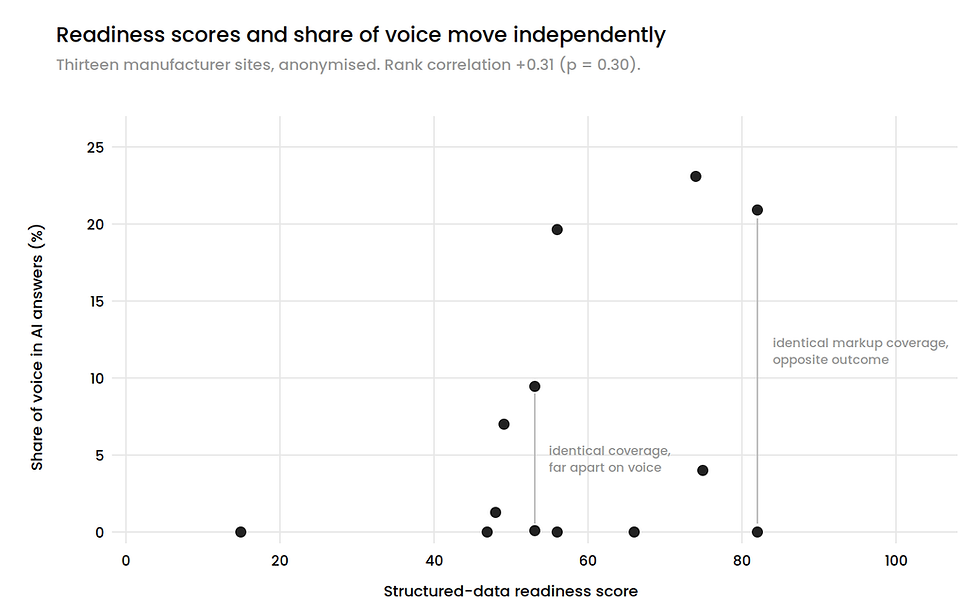
On the first six sites measured, structured-data coverage tracked share of voice closely, at a rank correlation of +0.94 on a sample that small. Adding the seven later sites drops it to +0.31 with a p-value of 0.30, which means no reliable relationship could be detected across thirteen sites. Two pairs show why:
Two sites score an identical 82 on structured data, and one holds 20.9% share of voice while the other holds none.
Two more score an identical 53, at 9.5% and close to zero.
Readiness behaves as a threshold: a site a machine cannot reach, cannot read or is told to discard has no path into an answer, and every brand in the bottom group fails at least one of those tests. Past the threshold, the readiness score stops predicting anything, and what separates 4% from 21% sits on the 89.7% of citation weight that lives on pages the brand does not own. The brands at the top of this table are cited through specialist test sites, retailers and magazines, and the brands at the bottom hold no third-party citations to be found.
What helps a brand get recommended in AI search?
Five things separate the top of this table from the bottom:
Presence on the two or three specialist test and comparison sites carrying disproportionate weight in the segment.
Coverage spread across source types instead of depth in one. Every brand here, the leaders included, is missing from at least two of the seven source clusters.
Retail and marketplace listings carrying descriptive text, since those domains out-cite manufacturer sites by a wide margin.
Product pages whose first paragraph answers the question in the heading.
Freshness signals a machine can read, absent across almost the entire category today and available to whoever moves first.
A brand in the bottom group adds one step ahead of those five, which is confirming that its own server, CDN and page headers admit the crawlers that feed AI answers. That step usually costs a configuration change, and the other five depend on it.
What happens after an AI visibility audit?
A study of this kind describes a starting position. The work that changes it runs in four stages, which AI, TELL ME! runs end to end for clients, and the fourth stage is the one that decides whether any of it paid:
Clear the access layer. Server, CDN and bot-manager rules, robots.txt, noindex directives and rate limits, checked against server logs instead of against a probe. Days of work, and nothing else counts until it is done.
Fix what a retrieval step reads. Main content wrapped so an extractor can separate it from navigation, opening paragraphs that answer their own heading, structured data with correctly cased types, and machine-readable dates on anything whose price or availability can change.
Work the sources the answers actually use. In this category that means the specialist test and comparison sites carrying the citation weight, the retail and marketplace listings that out-cite manufacturer domains, and the source clusters where the whole category is absent. This is the slowest stage and it moves share of voice the most.
Re-measure on a fixed cycle. The same prompt set, the same engines, weekly, with the website re-probed monthly. A change in share of voice means something when the question set has not moved underneath it.
Expect the access and readability work to show up in the citation data within weeks, because a page that could not be read before can be read now. Expect the off-site work to take a quarter or more, because it depends on other people publishing. Anyone promising faster movement on the second is selling the first.
A note on copying the leaders
Matching what the current leaders did puts a brand where they already are, one cycle late. The visible footprint shows what has worked so far, and it also shows what nobody has touched: community sources carry 3.5% of citation weight in this category on a single domain, the reference cluster carries 0.3%, and more than half of all cited domains hold one citation each. The surfaces nobody has used yet leave no trace in the data, by definition, which is the part worth testing as well.
How these findings sit against other published research
Three patterns in this study match what the published work on AI search measurement has reported, and one diverges.
Matching: the run-to-run variance inside a single engine, which is why this study reports one run as directional and treats a second reading as the thing that makes a trend; the dominance of third-party sources over brand-owned domains in the citation mix; and the weak carry-over from classic link building, where brand mentions and earned media predict citation better than backlink counts do.
Diverging: community and reference sources, which several published studies find acting as near-universal citation anchors across engines, are close to absent here. YouTube carries 3.5% of citation weight on a single domain and Wikipedia carries 0.3%. Ski hardware is sourced through specialist test sites and retailers instead, which is a category property worth checking before any cross-industry benchmark is applied to it.
Questions we are asked about AI visibility
How often should a brand measure its visibility in AI answers?
Weekly, on a fixed prompt set of about 50 prompts per segment. Daily runs add noise without adding information, and a single run captures one moment in a system that moves on its own. Two readings a fortnight apart are the minimum needed to tell a change from variance.
Does blocking AI crawlers remove a brand from AI answers?
It removes the brand's own website as a source, and the brand itself can still be recommended, because 89.7% of the citation weight in this study sits on pages the brands do not control. What a block costs is the ability to put your own description of your product in front of the model. In this study the brands with the highest share of voice are cited mostly through other people's pages.
Why does a brand appear in ChatGPT and not in Gemini?
Because the engines source differently. Across the same twenty questions, Claude cited 72 distinct domains, Google AI Mode cited 6, and Google AI Overview returned no source links in this run. An engine that cites narrowly is drawing on a small set of pages, so a brand absent from those few pages is absent from the answer, while an engine that shows no citations leaves no trail of which pages shaped its answer.
Does structured data get a brand cited?
It removes a reason not to cite the brand, and it predicts nothing on its own. Across the thirteen sites in this study with both measurements, structured-data readiness and share of voice correlate at +0.31 with a p-value of 0.30. Two sites with identical markup coverage sit at 20.9% share of voice and at zero.
Is an llms.txt file worth publishing?
Nobody can say yet, and four of the fifteen sites in this study publish one. Support across engines is not universal and the convention is young, so it costs little and proves nothing so far. It is worth tracking who publishes one and what happens to them.
Methodology and limitations
This study in numbers: one category, two segments, 20 prompts, six AI engines, 120 answers and 15 manufacturer websites probed. Citation figures cover the answers that returned sources.
Ten prompts per segment is a test scale, chosen to establish the shape of a category and the source set behind it. Working monitoring runs 50 prompts per segment, and every segment is monitored on its own, because presence differs sharply between segments: one brand in this study holds 9.5% share of voice on cross-country alone and appears nowhere in alpine.
One monitoring run, September 2026, German language, Austrian market.
Run-to-run variance is a property of these systems, so single-run figures are directional and a second run is what turns them into a trend.
The site check samples up to 25 pages per site, covering at least half of each site's main templates, plus the home page, robots.txt, the sitemaps and a crawler-identity matrix against the home page. It describes those templates and says nothing about sections outside them. Site scores are a relative scale for tracking change over time and have not been calibrated against how often a site is actually cited.
Access findings are reported at two confidence levels. Where the evidence sits in a page's own HTML or in a static file, or where a server answered some crawler names and refused others inside a single run, the finding describes the site. Where a site refused every request uniformly, the measurement stopped at the door and the report says so: a site can be protected against automated traffic in general and still admit the crawlers that feed AI answers, since those arrive from published address ranges a site can allow. Four sites in this set carry no crawler-access score for that reason, and the only place to confirm what their crawlers actually receive is their own server logs.
Website findings are published anonymised, since one probe describes what a test client received on one day and cannot prove what a live AI crawler receives. Each manufacturer can request its own AI Access Report.
The fifteen sites were measured in two groups two weeks apart, and the later group was checked against the eight crawlers that feed AI answers directly instead of the full sixteen identities. Access scores carry that method difference between the groups.
Two spellings of one brand appear in the source data and are merged throughout. One retailer domain carries a manufacturer ownership tag that looks like an error in the export, and it is excluded from the owned-domain figures.
Where to take this next
This study covers ski hardware in Austria. The same measurement runs for any category, in any market and language, on the same two halves: what the engines say and cite, and what their crawlers can reach and read.
AI, TELL ME! is a full-cycle AEO and GEO agency. We measure what AI engines say about a brand, assess what their crawlers can reach and read on its website, carry out the optimisation work that follows and re-measure it on a cycle. The monitoring platform and the AI Access Report behind this study are our own. The work is backed by more than 15 years in marketing, PR and SEO.
Book a 30-minute review of your own category: https://calendly.com/natali-khld/welcome
Request the prompt set, the engine-by-engine breakdown or the AI Access Report for your own website: hey@aipleasetellme.com
Written by a co-founder of AI, TELL ME! (aipleasetellme.com), 24 September 2026.